
Garden guide
Scan the QR tag on any plant, or pick one below. Fun fact: since we started building, the local iguanas have eaten more than 250 squashes and 350 watermelons.
68kinds of trees, palms and plants planted
88trees and palms planted so far
2,400swinglea for living fences
25wild plant kinds identified
Fruit trees · Native hereAvocado
(Persea americana)18 planted


This one is from our side of the world: avocados grow wild from Mexico down to Peru.
Hard green fruit hanging for months
- Flowers that switch
Each flower opens twice: first as a female, then it closes and reopens as a male. Different varieties keep different schedules, which helps them cross-pollinate.
- Ripens off the tree
Avocados grow on the branch but only soften after they fall or are picked. They can be left hanging for weeks, like a living fridge.
- From Bodhi MenteJulieta's favourite
Julieta, our black dog, is the resident avocado expert. She goes out, picks the best ones and eats them before we get the chance.
Pick a hard one and leave it on a table. It should be ready in one to two weeks.
Fruit treesOrange
(Citrus × sinensis)10 planted
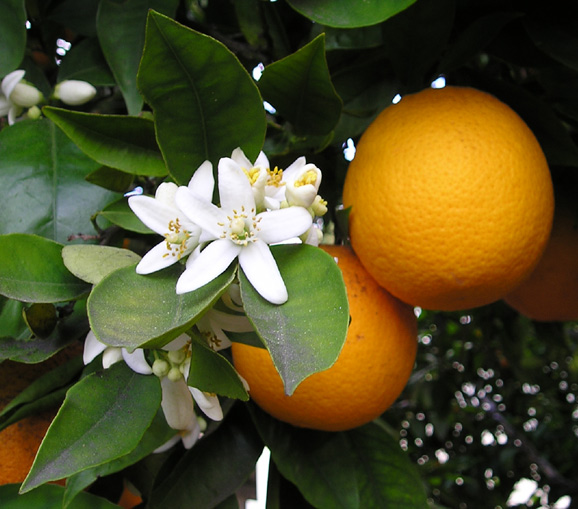
The orange isn't a wild species. It's an ancient cross between two older citrus fruits, the pomelo and the mandarin.
Ripe oranges that are still green
- From Bodhi MenteWhen a tree gives birth
Around here, people say a fruit tree pare, Spanish for "gives birth", when it starts to bear fruit.
- Green and ripe
In warm climates like this one, a fully ripe orange can stay completely green. The bright orange colour in shops is often brought out after harvest.
- An early traveller
Columbus may have planted oranges on Hispaniola in 1493. Within a century they had spread across the Americas.
Don't judge by colour. If it smells sweet and gives a little when you squeeze it, try it.
Fruit treesMandarin
(Citrus reticulata)10 planted


One of the original wild citrus. Most citrus fruits you know, oranges included, have mandarin in their family tree.
Loose skin that peels in one go
- An ancestor
The wild mandarin evolved in a small region of southern China and Vietnam, and it's a parent of the sweet orange and many other hybrids.
- Domesticated twice
Genetic studies suggest people domesticated mandarins at least twice, from two separate wild populations in China's Nanling Mountains.
- Built to peel
Its peel is thin and loose with very little white pith, which is why it comes off so easily and splits into neat segments.
Compare it with an orange: smaller, flatter, and much easier to peel.
Fruit trees · Native hereSapodilla · Níspero
(Manilkara zapota)4 planted


Before chewing gum was made in factories, it came from this tree.
Brown fruit with sandpaper skin
- The original chewing gum
The bark gives a white latex called chicle. The Maya chewed it, and from the 1880s to the 1950s it was the base of commercial chewing gum.
- Wood that sinks
The wood is so dense it sinks in water. The ancient Maya used it for temple beams and lintels because termites can't get through it.
- Worth the wait
An unripe fruit bleeds white latex and dries your mouth. When it's ripe, the skin goes soft and the flesh tastes sweet and malty, like brown sugar.
Gently scratch the skin with a fingernail. If it's green underneath, it needs more time.
Fruit trees · Native hereMamey Sapote
(Pouteria sapota)3 planted


The patience fruit. After the tree flowers, each fruit takes about two years to mature.
Rough brown fruit, salmon-red inside
- From Bodhi MenteSusi's ripeness alarm
Susi, our rat terrier, loves this fruit. She is the one who lets us know when the fruit is ready to pick up.
- The scratch test
Growers scratch a tiny patch of skin. If it's red underneath, the fruit is ready to pick. Then it needs five to seven days to soften.
- Cousin of the níspero
It's in the same family as the sapodilla, and the tree can grow 10 to 15 metres tall.
Find the níspero trees and compare: same family, very different fruit.
PalmsCoconut Palm
(Cocos nucifera)10 planted


Wild coconuts are built to sail. A thick, light husk keeps the seed afloat so the ocean can carry it to a new beach.
Flowers and fruit at the same time, all year
- A palm, not a tree
Palms don't make wood or grow rings. The trunk is a bundle of fibres, which is why it bends in a storm instead of snapping.
- The shark myth
You may have heard that falling coconuts kill more people than sharks. It's an urban legend. A full coconut is still heavy, though.
- From Bodhi MenteA second life
One of our palms died after a fire was lit too close to her and burned her roots. We didn't let her go to waste: her wood became the plant signs you see around the garden.
Don't hang your hammock right under a palm loaded with coconuts.
Fruit treesMalay Apple · Pera de agua
(Syzygium malaccense)2 planted


A tree that crossed the Pacific by canoe. It came from tropical Asia, and Polynesian voyagers carried it all the way to Hawaii.
Pink pompom flowers, then glossy red fruit
- A canoe plant
Polynesians brought it to Hawaii 1,000 to 1,700 years ago, as one of the plants they needed to start life on a new island.
- Made of water
The fruit is crisp, very juicy and mild, which is how it earned the name pera de agua.
- From Bodhi MenteFray's pick
These two were Fray's idea. Fray helps us run the finca and knew they would do well here.
When it flowers, the branch tips burst into pink-red pompoms. Look for them, then come back for the fruit.
TimberTeak
(Tectona grandis)6 planted


One of the most famous timbers in the world, and a surprising relative of mint and basil.
Leaves up to 45 cm long
- Mint family
Teak belongs to the Lamiaceae, the same family as mint, basil and oregano.
- From Bodhi MenteYou are standing on it
Natural oils in the wood keep out water, rot and termites, so teak lasts outdoors without varnish. That's why our villa decks are built from it: if you're staying with us, you're standing on this tree's wood.
- Leaves for cooking
In parts of Asia its huge leaves are used to wrap food. In Indonesia they give the dish gudeg its dark colour.
Touch a leaf: the top feels rough, like fine sandpaper.
Palms · Native hereRoyal Palm
(Roystonea regia)6 planted


The national tree of Cuba. Its smooth, pale trunk looks almost like a concrete column.
Smooth grey trunk with a green “neck”
- A green neck
Just below the leaves is a glossy green crownshaft, made of leaf bases wrapped around each other.
- From Bodhi MenteEl Palmar Real
In October 2025 we planted six royal palms to create El Palmar Real. Two didn't survive the wild rainstorm of February 2026. The four that made it are still standing tall.
- A palm with helpers
It was the first palm found with root nodules full of bacteria that pull nitrogen from the air, the way beans do.
Old leaves drop whole, and they're heavy. Don't stand under it on a windy day.
PalmsFoxtail Palm
(Wodyetia bifurcata)5 planted


Science only found this palm in 1968, on a remote, boulder-covered range in northern Australia.
Bushy leaves like a fox's tail
- Named for a keeper of knowledge
Its name honours Wodyeti, the last Aboriginal man known to hold traditional knowledge of the plants around Cape Melville.
- Black-market seeds
After it was described in 1983, demand exploded and collectors raided the wild palms. A single seed sold for up to 5 Australian dollars.
- Now everywhere
Nurseries grew it legally from seed, and today it's planted around the world. The city of Cairns alone has more than 1,500.
Look down a leaf from its tip: the leaflets stick out in every direction, like a bottle brush.
PalmsKentia Palm
(Howea forsteriana)10 planted


Every wild kentia comes from one tiny island in the Pacific: Lord Howe Island, off Australia.
Arching dark-green fronds
- The Victorian parlour palm
From the 1870s it became the fashionable indoor palm in Europe. Queen Victoria reportedly had them in all her homes.
- An island's seed business
Lord Howe still collects and exports its seeds around the world, under strict rules.
- Named after explorers
Its scientific name honours Johann and Georg Forster, naturalists on Captain Cook's second voyage.
It likes some shade. In strong sun its leaves can scorch.
PalmsBismarck Palm
(Bismarckia nobilis)1 planted


A giant from the savannas of Madagascar, named after Otto von Bismarck, the first chancellor of Germany.
Huge silver-blue fan leaves
- Leaves wider than a car
Mature leaves can grow more than 3 metres across.
- Fireproof
It grows in grasslands that burn often, and it survives the fires. In parts of Madagascar it's one of the few trees left standing on cleared land.
- Male and female
There are separate male and female palms. Only the females make fruit.
Step back and look at the colour: in morning light the leaves look almost silver.
PalmsBottle Palm
(Hyophorbe lagenicaulis)1 planted


In the wild it survives only on Round Island, a tiny islet off Mauritius, and it's critically endangered there.
A trunk swollen like a bottle
- From Bodhi MenteOur welcome palm
Ours stands at the entrance, the first plant to welcome you to Bodhi Mente. Gardens like ours help keep the species going while it recovers in the wild.
- Not a water tank
Many people think the swollen trunk stores water. It doesn't; that's a myth.
- Slow and short
It stays short for a palm and grows slowly, so this one will look much the same for years.
Notice how the trunk is fattest near the ground and narrows toward the leaves.
Palms · Native hereWashingtonia Palm
(Washingtonia sp.)4 planted


Named in 1879 after George Washington, the first president of the United States.
A skirt of old, dry leaves
- Desert fan palm
It comes from the dry canyons and oases of northwestern Mexico and the southwestern United States.
- A grass skirt
Dead leaves don't fall off. They hang down around the trunk like a skirt unless someone trims them.
- Sky-high
It can reach about 25 metres, which is why it towers over the streets of Los Angeles.
Watch the leaf stems: they have sharp, hooked teeth along the edges.
PalmsAreca Palm
(Dypsis lutescens)8 planted


One of the most planted palms in the tropics, yet in its home forests in Madagascar it's listed as Near Threatened.
Clumps of yellowish, bamboo-like stems
- A crowd, not a trunk
Each plant sends up many cane-like stems from its base, forming a clump shaped like a vase.
- Butterfly palm
Its leaves curve up from the stem like wings, which is why it's also called the butterfly palm.
- From Bodhi MenteOur fastest grower
We love this palm. It has grown faster than any other plant on our land, and left alone a clump can reach 6 to 12 metres.
Look at the stems: they're ringed like bamboo and turn golden in the sun.
Living fencesSwinglea
(Swinglea glutinosa)2,400 planted


Our living fences. Instead of wire and posts, we planted 2,400 swinglea to mark the land.
Dense green walls along the paths
- A one-of-a-kind cousin
From the Philippines, it is the only species in its genus and part of the citrus family, like our oranges and mandarins.
- From Bodhi MenteTwice the plan
We first thought we would need 1,200. We ended up planting twice that.
- Hedge or tree
Kept trimmed, it grows into a thick barrier. Left alone, it becomes a small tree of 3 to 6 metres.
Follow a fence line and notice how tightly the branches close. That is what keeps it working as a fence.
Bodhi means awakening. This is the cup for it.
Coming soonA slower cup for the afternoon, no rush.
Coming soonPure cacao, made to sip slowly.
Coming soonAsk at reception to buy any of these.
Questions guests ask
What grows at Bodhi Mente?
We have planted 68 different kinds of trees, palms and plants on our land near Tayrona, including avocado, orange, mandarin, níspero (sapodilla), mamey sapote, coconut, pera de agua (Malay apple), teak and royal palms, plus 2,400 swinglea as living fences. We've also identified 25 kinds of wild plants so far, and we're still counting.
How many trees have you planted?
Since we started building we have planted 102 trees and palms. We lost or removed 14 along the way, a net gain of 88. We don't count plantains: botanically they're giant herbs, not trees.
How do the QR tags work?
Each plant has a QR tag. Scan it with your phone's camera and this guide opens on that plant, with its story and facts.
Do you make your own coffee or cacao?
We're preparing Bodhi Mente coffee (Despertar and Pausa) and cacao (Raíz). They're coming soon.
Follow us
Watch the garden grow, the villas take shape and the animals come by.