
The land
Thirteen hectares in Mendihuaca, near Tayrona. Here's what we've built on it, and the stories you won't find on a booking site.
13hectares of land
2villas
~1km of water line
Find your way around
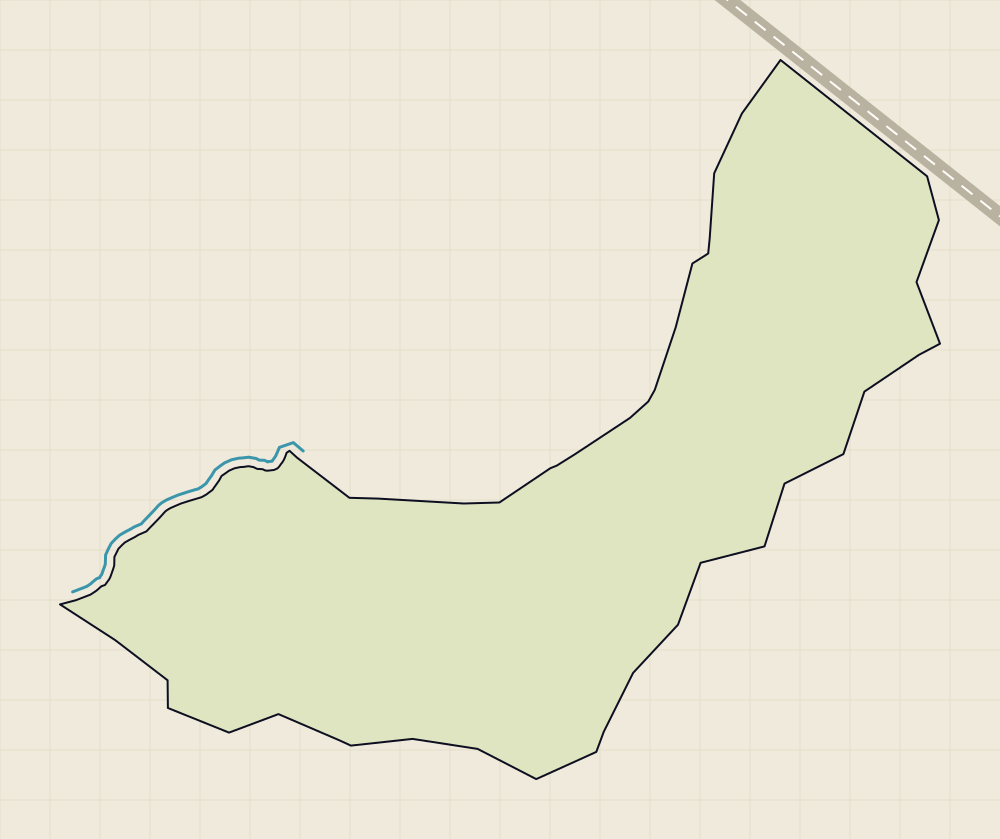 TRONCAL DEL CARIBEQuebrada Seca
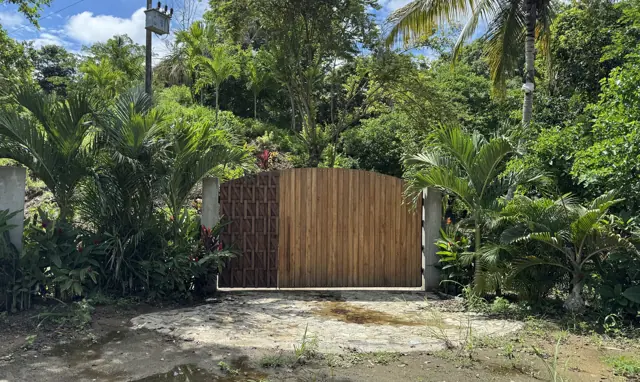 Main entranceWhere it all starts
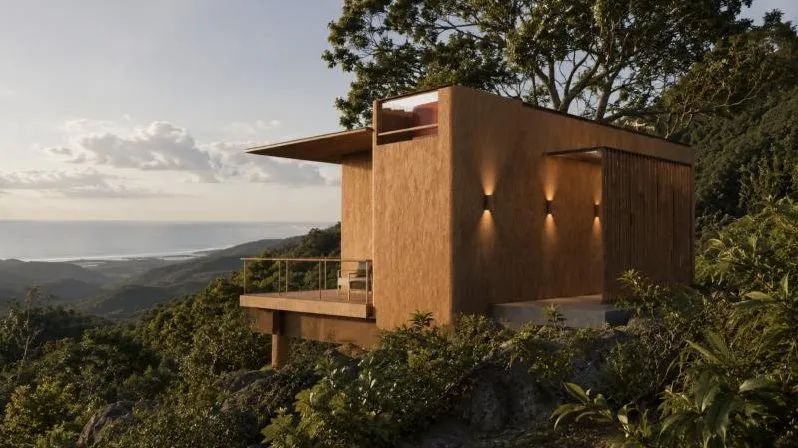 Villa Fresa · Villa 1Let the view do the decorating
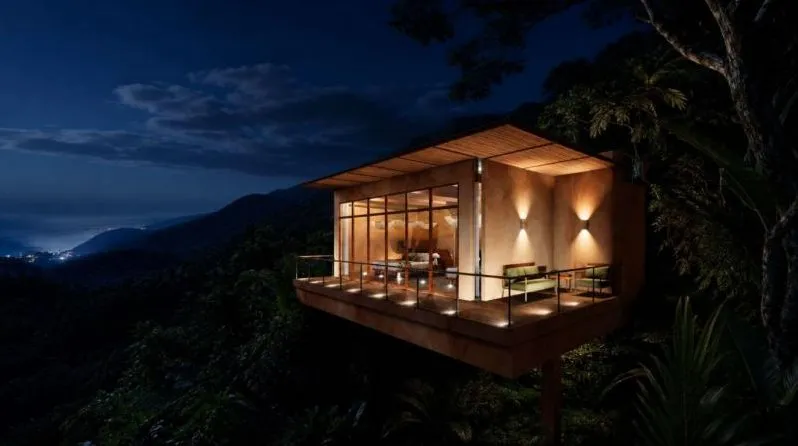 Villa Coral · Villa 2Built for this coast
 Avocado Bay 1Julieta's patrolAvocado Bay 2The second grove
 El Platanal 1The first plantain grove
 El CocalThe coconut grove
 Susi's CornerThe sapote grove
 The Teak TrailThe teca path
 La CatedralGuadua Bay 1El SusurroGuadua Bay 2
Every corner of the land
01 · AccessMain entrance
Where it all starts
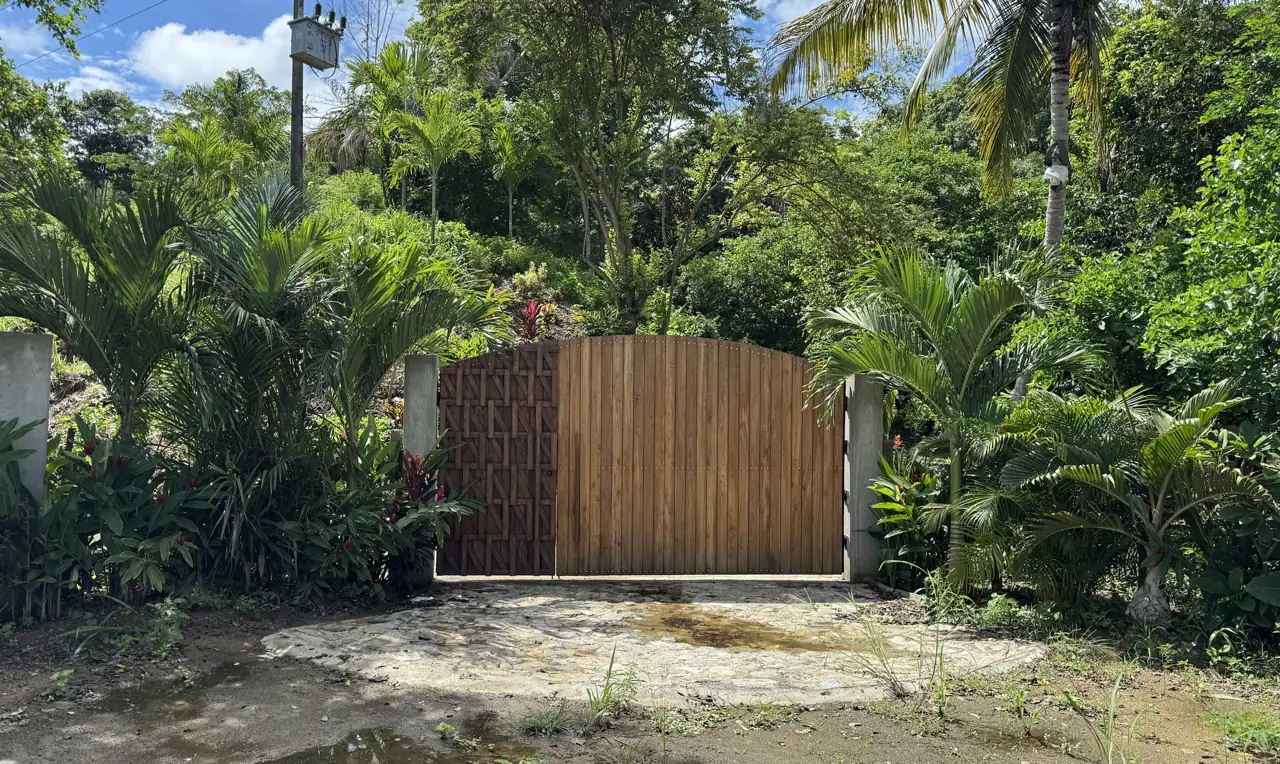
Photo: Bodhi Mente *
The first thing you see from the Troncal del Caribe: a teak gateway wrapped in green.
- 11 kinds of plants
Count them on your way in: the entrance alone has 11 different types of plants.
- A rare welcome
The small bottle palm by the gate belongs to a species from tiny Round Island, off Mauritius, where it is critically endangered in the wild.
- Built in teak
The entrance is made of teak, the same wood as the villa decks. Its natural oils keep out water, rot and termites, so it weathers the coast without varnish.
02 · VillaVilla Fresa · Villa 1
Let the view do the decorating
Render: Bodhi Mente *
The first of our two villas, designed around one idea: nothing should stand between you and the view.
03 · VillaVilla Coral · Villa 2
Built for this coast
Render: Bodhi Mente *
Villa 1's twin, with the same glass front and floating deck, and a structure made to last by the sea.
04 · ReceptionBodhi House
Reception, for now
For now, Bodhi House is our reception: this is where you check in when you arrive.
05 · HomePack HQ
The dog enclosure
Headquarters for the four-legged part of the team.
- Meet the team
Julieta is our avocado expert and Susi is our sapote alarm. Look for their work in Avocado Bay 1 and Susi's Corner.
06 · NatureMonte Despierto
The awakened mountain
Bodhi means awakening. Our mountain is waking up too: it's planted with more than 26 different kinds of plants.
- 26 kinds and counting
On this mountain alone grow more than 26 different types of plants.
07 · GroveAvocado Bay 1
Julieta's patrol

Photo: Wikimedia Commons (Persea americana)
The first of our two avocado groves, and the favourite stop of our resident fruit inspector.
- Julieta's favourite
Julieta, our black dog, is the resident avocado expert. She goes out, picks the best ones and eats them before we get the chance.
- Flowers that switch
Each avocado flower opens twice: first as a female, then it closes and reopens as a male. Different varieties keep different schedules, which helps them cross-pollinate.
08 · GroveAvocado Bay 2
The second grove
Photo: Wikimedia Commons (Persea americana)
Our second avocado grove. Together the two bays hold 18 avocado trees.
- A living fridge
Avocados grow on the branch but only soften after they fall or are picked, so they can be left hanging for weeks.
- 18 and growing
Between Avocado Bay 1 and 2 we have planted 18 avocado trees, more than any other fruit on the land.
09 · GroveEl Platanal 1
The first plantain grove

Photo: Wikimedia Commons (Cooking banana)
Every Caribbean kitchen needs a platanal. This is ours.
- A giant herb
A plantain isn't a tree. Its 'trunk' is made of tightly rolled leaf bases with no wood inside, and the plant can still grow 6 to 7 metres tall.
Source: Encyclopedia.com (Gale) - Not in our tree count
Because they're herbs, not trees, we leave plantains out of our trees-planted counter. We'd rather keep it honest.
10 · GroveEl Platanal 2
The second plantain grove
Photo: Wikimedia Commons (Cooking banana)
Our second platanal, because one is never enough on the Caribbean coast.
- Cook first
Plantains are a group of about 75 varieties of banana that are eaten cooked: patacones, tajadas, chips or flour.
Source: Encyclopedia.com (Gale) - One harvest each
Each plantain stem fruits once and then dies back to the ground. A new shoot from the same base takes its place.
Source: Encyclopedia.com (Gale)
11 · GroveEl Cocal
The coconut grove

Photo: Wikimedia Commons (Cocos nucifera)
Ten coconut palms swaying in the sea breeze.
- Bends, doesn't break
Palms don't make wood or growth rings. The trunk is a bundle of fibres, which is why it bends in a storm instead of snapping.
- A second life
One of our palms died after a fire was lit too close and burned her roots. Her wood became the plant signs you see around the land.
12 · GroveEl Nisperal
The níspero grove


Photo: Wikimedia Commons (Manilkara zapota)
Our níspero trees, the fruit that once gave the world chewing gum.
- The original chewing gum
The bark gives a white latex called chicle. The Maya chewed it, and from the 1880s to the 1950s it was the base of commercial chewing gum.
- Wood that sinks
The wood is so dense it sinks in water. The ancient Maya used it for temple beams because termites can't get through it.
13 · GroveSusi's Corner
The sapote grove

Photo: Wikimedia Commons (Pouteria sapota)
Our sapote trees, guarded by the smallest member of the team.
- Susi's ripeness alarm
Susi, our rat terrier, loves this fruit. She is the one who lets us know when the sapotes are ready to pick up.
- The scratch test
Growers scratch a tiny patch of skin. If it's red underneath, the fruit is ready to pick. Then it needs five to seven days to soften.
14 · GroveThe Teak Trail
The teca path

Photo: Wikimedia Commons (Tectona grandis)
A path lined with teak, the same wood you walk on in the villas.
- You've stood on it
Teak's natural oils keep out water, rot and termites, so it lasts outdoors without varnish. That's why our villa decks are built from it.
- Mint family
Teak belongs to the Lamiaceae, the same family as mint, basil and oregano.
15 · GroveCitrus Bay
Oranges & mandarins
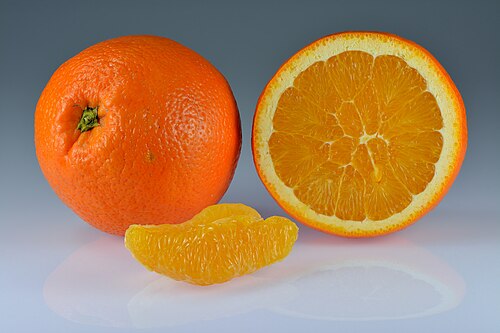

Photo: Wikimedia Commons (Orange (fruit))
Ten oranges and ten mandarins, side by side.
- Green and ripe
In warm climates like this one, a fully ripe orange can stay completely green.
- Mother and daughter
The wild mandarin is one of the parents of the sweet orange, so Citrus Bay is a family reunion.
16 · GroveLa Catedral
Guadua Bay 1

Photo: Wikimedia Commons (Guadua angustifolia)
Stand inside a guadua grove and look up: the tall canes close over you like the roof of a cathedral.
- A grass, 30 metres tall
Guadua is a bamboo, which makes it a giant grass. Its canes can reach 20 to 30 metres.
Source: ECHO Community - Colombia's building cane
It's the most important bamboo in tropical America and the main building material for many homes in Colombia and Ecuador.
Source: ECHO Community
17 · GroveEl Susurro
Guadua Bay 2
Photo: Wikimedia Commons (Guadua angustifolia)
Our second guadua grove. Come when the wind picks up and listen to the canes whisper and knock.
- From right here
Guadua is native from Venezuela to Peru, so this bamboo is at home on our coast.
Source: ECHO Community - Cousin of the road grass
Like the vetiver along our road, guadua is a grass: the same family, at a very different size.
18 · WaterWater well
Where every drop starts
All the water in the villas comes from our own well, 25 metres deep.
- 25 metres down
The well goes 25 metres into the ground, about as deep as an eight-storey building is tall.
- A 1 km journey
The water that reaches each villa has travelled about 1 kilometre through our water system.
- Warm on sunny days
There's no water heater. On sunny days the water gets warm during the day; on cloudy days it stays cool.
* Photos and renders © Bodhi Mente SAS. Please ask us before using them.
Questions guests ask
Where is Bodhi Mente?
At Km 39 on the Troncal del Caribe in Mendihuaca, Magdalena, Colombia, near Tayrona National Park. The land covers 13 hectares.
What are the villas like?
There are two villas. Each has a floor-to-ceiling glass front 3.4 metres tall and a cantilevered teak deck with steel-cable railings, so nothing blocks the view.
Is there hot water?
There's no water heater. On sunny days the water gets warm during the day; on cloudy days it stays cool. It comes from our own well, 25 metres deep, and travels about 1 km through our water system to each villa.
What else is on the land?
Groves of avocado, citrus, coconut, plantain, níspero, sapote, teak and guadua bamboo, plus a mountain planted with more than 26 kinds of plants.
Follow us
Watch the garden grow, the villas take shape and the animals come by.